


Voting methods
Voting methods
New voting methods can strengthen democracy by broadening representation and allowing voters to express their choices in new ways.
Most US elections are for a single person to be elected by a majority or plurality vote. This can force voters to choose between voting for the candidate they prefer and strategically voting for the one they think has the best chance of winning. However, voters are interested in ballots that allow more choices.
New voting methods like ranked choice voting, proportional representation, and cumulative voting give voters tools for expressing a more nuanced choice as they mark their ballot.
These new ways of voting bring promise of a stronger democracy, but also require new – and sometimes unfamiliar – ballot designs. Our research explores how to communicate with voters, so they understand how to mark their ballot to express their opinions accurately.
Our goal in this research is to help election officials and democracy advocates consider voters’ needs as they plan and implement new voting methods.
Related topics in running elections:
Voting method subtopics
Proportional representation
Proportional representation is a voting method that elects multiple representatives in each district in proportion to the number of people who vote for them. There are several methods for proportional representation, each reflecting a different way of thinking about candidates and parties.
The most common variety commonly used in the US is multi-member districts using ranked choice voting (Proportional RCV). Other methods of proportional representation can help address the challenge of drawing fair legislative districts.
In 2025 and 2026, we conducted two exploratory studies to learn what ballot designs would help voters understand how different voting methods work. The methods included ranking, cumulative, and approval voting
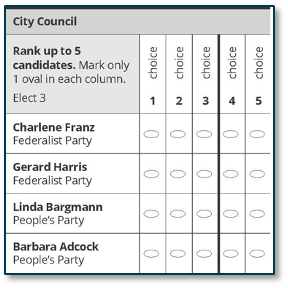
- Exploring reactions to proportional representation ballots. How ballot designs can help voters understand how different voting methods work.
- Exploring mental models for understanding elections. How mental models affect understanding of contests with more than 1 candidate elected.
Another study tested voter reactions and understanding of multi-winner ranked choice (PRCV) voting. This research was conducted in Arlington County, VA and Portland, OR.
- How to display results for multi-winner ranked choice voting elections. What helped voters understand how winners are selected in this voting method.
Mixed member proportional
Mixed member systems (MMP) is a form of proportional voting used successfully in countries including Germany, Ireland, and New Zealand. Voters make two choices: they select a party they want to lead the legislature, and also vote for individual members of parliament.
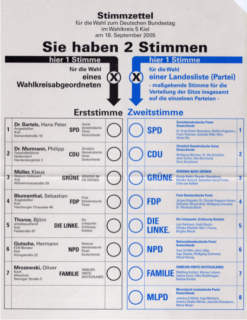
One suggestion is that a state legislature or county council might have both single-winner districts and a number of at-large seats, with seats allocated based on each party’s share of the vote.
How could MMP be adapted to the US electoral system? We explored this question in both a research project and a design exploration
- Designing mixed-member proportional ballots for the US. An exploration of adapting MMP to US elections.
- Exploring mental models for understanding elections. An English version of the German MMP ballot was included in this research.
Cumulative voting
Cumulative voting is a multi-winner voting method in which voters can mark all of their votes for a single candidate or split them across multiple candidates. The winners are those who receive the most votes. For example, in an election for 3 seats on a council, voters can cast 3 votes for any combination of candidates which could look like 3 votes for a single candidate, or 1 vote each for 3 candidates.
In 2010, when Port Chester, New York, adopted cumulative voting, a usability test was conducted of both the education materials and 4 versions of the ballot and voting instructions. Voters made two kinds of mistakes. One group undervoted, marking their choices once, and not using the remaining voting options. Two participants overvoted by selecting all 6 bubbles for each of their preferred candidates – that is marking 36 total selections.
Even in a small qualitative test, it was clear that voters needed targeted education around the ability to vote more than once for the same candidates.
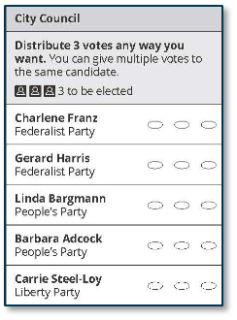
Voter education should include:
- Concrete examples of how different options pictured in the voter education translated to selections on the voting machines.
- Opportunities to practice voting to build confidence and familiarity with the mechanics of cumulative voting.
- Examples that stress the relationship of the marking targets to the number of selections allowed.
- Handouts at the polling place that remind voters about the rules for cumulative voting.
Two post-election reports showed the effectiveness of the intensive voter education campaign in an election that resulted in the first Hispanic council member being elected.
- Voter Competence with Cumulative Voting →
David Kimball and Martha Kropf in Social Science Quarterly - Cumulative Voting Educational Program Exit Poll Report for Port Chester, NY → David Kimball and Martha Kropf
Report: Ballot Usability Feedback – Port Chester Votes
Test conducted March, 2010 at Port Chester Village Hall
(Download .docx version)
Our work
Research: Designing ballots for new voting methods
New ways of voting need new – and sometimes unfamiliar – ballot designs. We want to make sure that voters’ needs are a building block of any changes to elections.
Our research examined prototype ballot designs to determine what helps voters understand proportional representation elections and builds confidence.
We conducted two exploratory studies to learn what ballot designs would help voters understand how different proportional representation contests work and vote accurately and confidently.
- Exploring reactions to proportional representation ballots. This research focused on how ballot designs can help voters understand how proportional representation works and how to mark their ballots.
- Exploring mental models for understanding elections. This research explored what mental models affect understanding of proportional representation and how ballots can help voters identify and understand contests with more than 1 candidate elected.
Other resources
Information from other organizations that have descriptions and a summary of the pros
and cons of other voting methods. CCD does not endorse these organizations, but found their explainers useful.
Proportional representation
Mixed Member Proportional
Cumulative voting

© 2025 Center for Civic Design