


Cure mailer template
Cure mailer template
In every state, mail voters must sign their ballot envelope when they return it. In 33 states, if a voter forgets to sign their return envelope or the signature doesn’t match the one on file, their election office must contact them to fix the problem. This process, which provides the voter with an opportunity to correct their mistake, is called ballot curing. When administered well, it provides an important safeguard for mail voters.
It’s worth remembering that voters are highly motivated to complete the cure mailing.
They’ve already done everything right: registered, requested a ballot, researched the candidates, and filled everything out. There’s just one small problem standing between them and a counted vote. That’s a great starting point for a successful cure process, as long as the mailing meets them where they are.
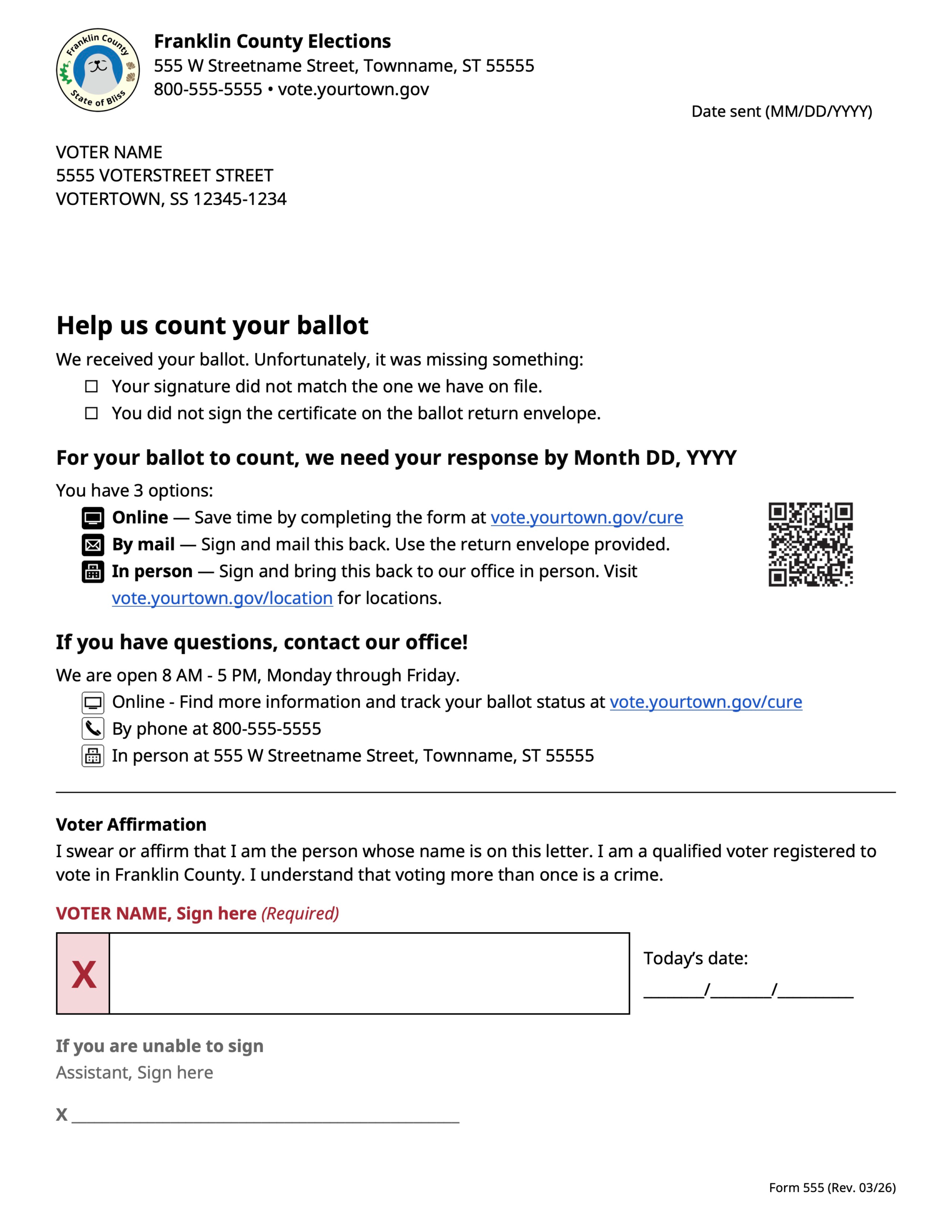
Cure mailer template
Get started with the editable template below.
Or see this template as a pdf.
Download (.docx)Key elements of a cure mailer example
A cure mailer has 1 purpose: to make sure that the voter can get their ballot counted. Like all voter response mailers, it both informs and gathers information from the voter. It’s important to clearly separate the notice and form so voters understand what they’re reading.
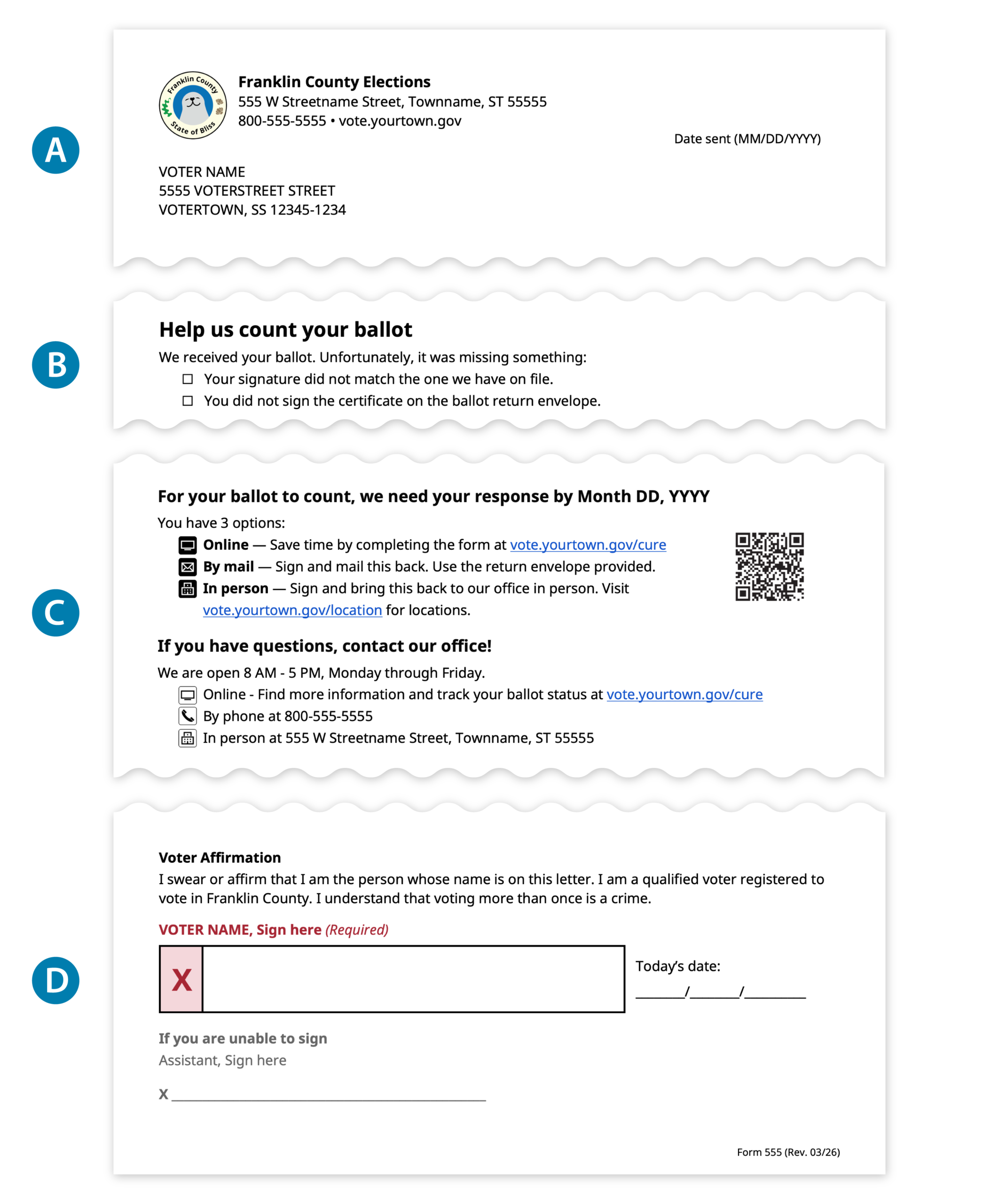
Here’s how each section of the template works and what to keep in mind as you adapt it.
-
The header
Lead with your office logo and contact info so voters recognize this as official mail. -
The problem
Tell the voter the problem clearly as a main heading. They should know immediately why they’re receiving this. Checkboxes make the specific issue clear without over-explaining. -
The call to action
The response options and deadline. Bold the deadline so it’s impossible to miss, then give every available path to cure — online, mail, in person. Less text, more clarity. Put your preferred response option first so voters read it first. -
The signature form
This is what makes the ballot count. Use our signature field and include an assistant line for accessibility. Use the same size signature box as your mail ballot envelope.
How to write an effective cure mailer using our template
These are our main tips we recommend to write an effective cure mailer.
Stick to the main points
The core pieces of a cure mailer are communicating that:
- Your ballot has been received
- There’s a problem that’s preventing it from being counted
- Clear simple instructions for fixing the problem
- The deadline to respond
- How to confirm the cure was successful and their ballot counted
Only include what’s required
Before adding anything beyond those core elements, pause and ask yourself whether it’s truly necessary. Legal citations, for example — are they required? If so, can they live at the bottom of the page where they won’t compete with the main message? And on the form itself: if the voter’s name and address already appear at the top, do they really need to write it again? Less is almost always more here.
Balance friendliness and urgency
Tone matters a lot here.
For most voters, the window to cure is tight, sometimes just days. That means the mailing needs to feel helpful and human while also making the deadline impossible to miss. Get to the point quickly, using plain language, and cut anything that isn’t directly helping the voter take action.
Customize the mailer to work for you
Everyone’s cure process is a little different, so these templates are designed to be flexible.
How complex is your cure process?
In some states, there are only 2 reasons a voter must complete a cure mailer: a missing signature or a signature that doesn’t match the one on file. The cure method is the same for both.
In other states, a cure mailer might be sent because the voter hasn’t provided a copy of their ID or because they didn’t put their ballot in a secrecy envelope. These reasons might require the voter to do something other than just sign and return the mailing.
If your state has multiple cure reasons, you have 2 options:
- Design a mailer for each reason so the voter receives a message tailored to their specific circumstances.
- Design 1 mailer with checkboxes for the reason and corresponding checkboxes for the ways to cure. The voter first sees why their ballot can’t be counted, then the steps to fix it.
How to customize the mailer
The biggest step to customizing the mailer is updating the language, including:
- The cure reasons
- Response options
- Voter affirmation
- Add any additional required form fields
- Your contact information
- The voter’s name at the top, and above the affirmation
How will you send the letter?
You’ll need to adjust the mailer depending on how you will mail it to voters. This template is designed to be used with a windowless envelope. If you’re using a windowed envelope, adjust the top third of the mailer so that the voter’s name and address fall in the correct zone.
Will your cure mailer be prepared by hand or come directly from your election system?
If you plan to send the cure mailers by hand, use the checkboxes in the template to list all the possible reasons and check off the one that applies.
If your cure mailers will be generated directly from your election system, you can customize it more:
- If you have individual voter bar codes, include them below the signature area for easier processing.
- Only print the specific cure reason for each voter

Test your work as you go
As you make changes, make sure to:
- If your cure mailer runs to 2 pages, keep the notice on one side and move the form to the back to maintain clear separation
- Print and test the mailer. If you’re using an envelope with a window, does the address line up correctly?
- Is there enough space for a voter to sign their name?
- Check that the icons are in line with the text
Tell us what you think
This year, we’re working to share tools that you can use immediately to make more effective voter-facing materials.
We’re building this toolkit in the open and want your input:
- Do you have feedback on this template?
- Can we help you problem solve how to design for your cure process?
- Do you have data on how many people successfully use your existing cure process? What have you seen work well or not work well?
We’d love to hear from you. Email us at hello@civicdesign.org

© 2025 Center for Civic Design