


Roadmap for Usability and Accessibility of Next Generation Elections
Roadmap for Usability and Accessibility of Next Generation Elections
In 2015, we worked with the NIST Voting Project to create a roadmap for work on the next generation of voting systems and voting system guidelines. The roadmap included a history of work towards accessible and usable voting systems, and explored how to achieve the goals of the Help America Vote Act (HAVA) requirements for independent and private voting for all voters.
The roadmap aimed to:
- Increase the level of knowledge about how to create election systems with good usability and accessibility.
- Promote consistent levels of usability and accessibility across all parts of the elections process.
- Make systems more usable for everyone in the elections process, including voters, poll workers, elections staff, and advocacy or support workers.
- identify the appropriate guidance—including guidelines for best practices, procedural support, and training—rather than a single focus on standards and certification.
Work on the roadmap took a voter-centered approach, rather than limiting the scope to the systems. We hoped that this roadmap would serve the entire election community: election officials, people who design, build, or test election systems, voters, and election advocates who share the goal of making elections more usable and accessible for everyone.
In 2018, we looked at work in the field and found that significant work had been done in all priority areas, both through NIST and EAC projects and in other elections research or activities at universities, by vendors, and in elections offices.
Read the report on progress towards the roadmap goals.

A roadmap for usability and accessibility of future voting systems
Download report (PDF)Key findings
The roadmap is organized into 6 priority areas
Each priority area is a goal for improving elections, with for work that identify gaps in current practice and knowledge, provide an overview of the challenges and risks, outline steps towards meeting the objectives, and list existing resources to support the work.
Priority Area 1: Support the design process: Improve knowledge of human factors in election design
- 1.1 Design standards and guidance so they are easier to use
- 1.2 Share best practices and techniques that meet human factors goals
- 1.3 Create educational programs on human factors for system designers
- 1.4 Create guidance on effective design processes
- 1.5 Make data available to analyze and improve the voter experience
Priority Area 2: Engage voters effectively: Introduce and use best practices for election information and voter guides
- 2.1 Create guidance on effective election communications and personalization
- 2.2 Make voter education available to everyone, including practice with real
- voting systems
- 2.3 Improve voter guides, making them more usable and accessible
Priority Area 3: Address the entire voter journey: Support a coherent voter experience across all activities
- 3.1 Support voters as they move between election systems
- 3.2 Create a risk model that includes human factors and security
- 3.3 Enable “anywhere voting”
Priority Area 4: Support evolving technology: Include a wider range of technology in elections
- 4.1 Use universal design to create systems that work for more voters
- 4.2 Enable the use of personal devices and assistive technology to vote
- 4.3 Update voting guidance to address new technologies and interactions
- 4.4 Create guidance for election systems outside of the “voting system”
Priority Area 5: Provide useful guidance and standards: Make standards and other materials effective
- 5.1 Merge usability and accessibility into a single universal standard
- 5.2 Simplify guidance by focusing on principles
- 5.3 Develop performance metrics
- 5.4 Develop process standards
Priority Area 6: Improve testing in design and certification: Make the process effective
- 6.1 Improve ways to test systems, including pilot testing as part of certification
- 6.2 Certification of open, component-based election systems
- 6.3 Establish qualifications of human factors evaluators
The roadmap suggests a model for how different levels of guidance can work together
Starting from principles for elections and including both core standards that apply across all systems, guidelines for specific systems, and useful materials such as training, testing methods, samples, and scenarios can all work together.
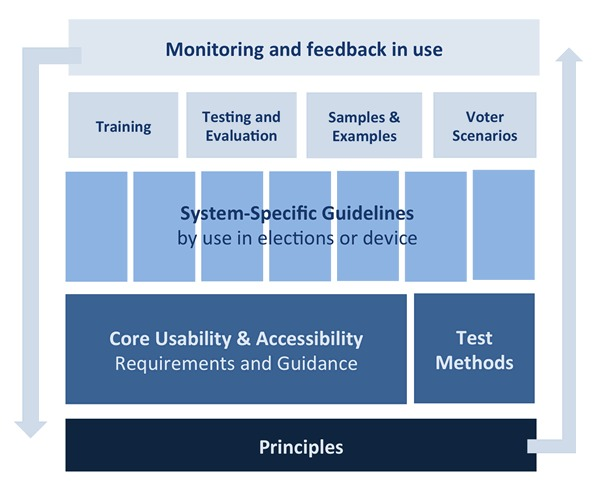
Starting from the bottom up, this model includes:
Samples and examples. Illustrations and code samples that show best practices for meeting both core and system-specific guidance.
Principles. Clear statements of overarching goals that help everyone understand the reason for any requirement or guideline.
Core usability & accessibility requirements. Guidelines and requirements that apply to any interactive system or election function.
Test methods. Test methods for certifying that the core requirements are met.
System specific guidelines. Extensions to the core requirements that apply to different election systems or specific types of devices.
Training. Knowledge transfer and support for those new to the field or for continued learning.
Testing, Evaluation and testing methods that can inform the design of any election system.
About the research
This research was conducted by team members from Center for Civic Design and the University of Baltimore, working with the NIST Voting Project.
The roadmap is the result of discussions with stakeholders such as the Election Assistance Commission, state and local election officials, system vendors, researchers, and others about the needs for better guidance for usability and accessibility of future election systems.
The input for this roadmap came from a review of current research on voting systems and active consultation with experts and other stakeholders in the field.
We sought out diverse viewpoints so many different stakeholder perspectives are included. We held three workshops with experts including election officials, researchers, system designers, policy experts, and disability advocates, each focused on a different aspect of the work.
- October, 2014. The first workshop asked, “What will the experience of elections be like in the future?” (pdf or pptx)
- January 2015. The second workshop looked at how guidance and certification process can be improved, and asked, “What objectives can help us meet the goals of usable and accessible elections?” (pdf or pptx)
- February 9, 2015. The preliminary report was presented at the Future of Voting Systems Symposium, where we also ran a workshop to collect input on priorities for the objectives. Preliminary draft roadmap (pdf)
- February – April, 2015. We asked for comments from all participants in the workshops, and anyone else interested in the process.
- July 2015. A second draft was released for the TGDC meeting on July 20-21. Second draft roadmap (pdf) Updated poster of priority areas and objectives (pdf)
- February 2016. We conducted an analysis of the usability and accessibility requirements to see if we could meet the goals to provide useful guidance and standards and treat usability and accessibility in a single universal standard. Principle-based requirements: Exploring a revised structure for usability and accessibility in the VVSG (pdf)
- 2018. Progress report 2015-2018. How the goals of the roadmap have been met, at the EAC, NIST, and beyond.
This work was completed under grants and contracts from the U.S. Department of Commerce, National Institute of Standards and Technology. Special thanks to students from the University of Baltimore, everyone who participated in the roadmap workshops, and all the people who have helped with the research over the years.
Related resources
Visit our page on voting systems to find more resources about the usability and accessibility of voting systems.

© 2025 Center for Civic Design